Insights

Major financial decisions often don’t stay in one lane.
A business sale can affect investments, taxes, estate documents, protection planning and retirement income.
A job change can affect compensation, benefits, cash flow and old retirement accounts.
A concentrated position can affect both opportunity and risk.
Your investment, tax, legal, protection and retirement decisions may each involve different professionals, and sometimes the challenge is simply making sure the pieces are being considered together.
That is where I believe a coordinated approach to financial decisions matters.
Not pretending to replace the CPA, attorney or other professionals.
Not forcing every decision into an investment conversation.
But helping define the decision, identify the tradeoffs, ask the questions that may otherwise get missed and keep the moving pieces connected.
Because a decision can make sense by itself and still create a problem somewhere else.
The goal isn’t more complexity.
It’s clearer decisions.
See thrivent.com/social for important disclosures.

The Financial Work After a Job Change
A new role can be the right career move and still leave financial loose ends.
Compensation changes. Benefits change. Insurance coverage changes.
Depending on plan rules, options for an old employer retirement account may include leaving it in place, moving it to a new employer’s plan if accepted, rolling it into an IRA or taking a cash distribution. Each option can involve different investments, fees, services, tax treatment and withdrawal rules. A cash distribution may trigger income taxes and an additional early-distribution tax.
Then there may be equity compensation, an HSA, withholding elections or benefits from the prior employer that still need attention.
None of those decisions should overshadow the new opportunity.
But they should not be left on autopilot either.
If you’ve recently changed roles, it’s worth taking a little focused time to review the financial side.
Not because everything needs to change.
Because several independent decisions may have changed at once.
Sources: IRS; U.S. Department of Labor.
See thrivent.com/social for important disclosures.

A Business Sale Is More Than a Wire Transfer
Planning for a business sale shouldn't start after the wire hits.
A sale can change more than your bank balance.
It may affect your income, taxes, estate strategy, charitable plans, insurance needs, investment risk and the role the business used to play in your identity.
And those decisions often interact.
A structure that looks attractive from one angle may create an unintended consequence somewhere else. That is why the important conversations commonly involve coordinated input from financial, tax and legal professionals before the transaction is finalized.
The real planning question isn't only: "What is my business worth?"
It's: "What does the value need to make possible after the business is no longer producing my paycheck?"
A liquidity event is not the finish line.
It is the point where business capital becomes personal capital—and suddenly has several new jobs to do.
Sources: SBA; IRS.
See thrivent.com/social for important disclosures.

What Job Is the Cash Supposed to Do?
Cash can feel productive simply because it is earning interest.
A savings account, money-market deposit account or CD may be doing exactly what you need it to do.
But “earning interest” and “serving the right purpose” are not always the same question.
Some cash may be for:
Emergencies
Taxes
Payroll or business opportunities
A purchase in the next few years
Emotional comfort
A goal with no defined timeline
Inflation reduces a dollar’s purchasing power over time, so money intended for longer-term goals faces a different tradeoff than money needed next quarter.
That doesn’t mean cash is bad.
It means cash needs a job description.
If a large balance has accumulated because the next decision kept getting postponed, it may be worth asking what job that cash is supposed to do.
The answer, not the headline interest rate, should drive the next conversation.
Sources: BLS; FINRA.
See thrivent.com/social for important disclosures.

The DIY Investor
Being good with money doesn’t mean you can’t value a second perspective.
They track their accounts. They understand fees. They research investments. They may even enjoy building the spreadsheet.
That doesn’t mean they need someone to take over.
It may mean they value a second set of eyes when decisions become more complex or carry lasting consequences:
Exercising stock options
Selling a business
Retiring earlier than planned
Concentrating more wealth in one investment
Coordinating a decision with tax or estate professionals
Deciding what not to change during market stress
I’m not here to take over your spreadsheet.
I’m here to help you think through decisions with lasting financial consequences.
Sometimes the value of advice isn’t having someone make every decision for you.
It’s having someone help you slow down, test the assumptions and see how one decision affects everything else.
Sources: Investor.gov; FINRA.
See thrivent.com/social for important disclosures.
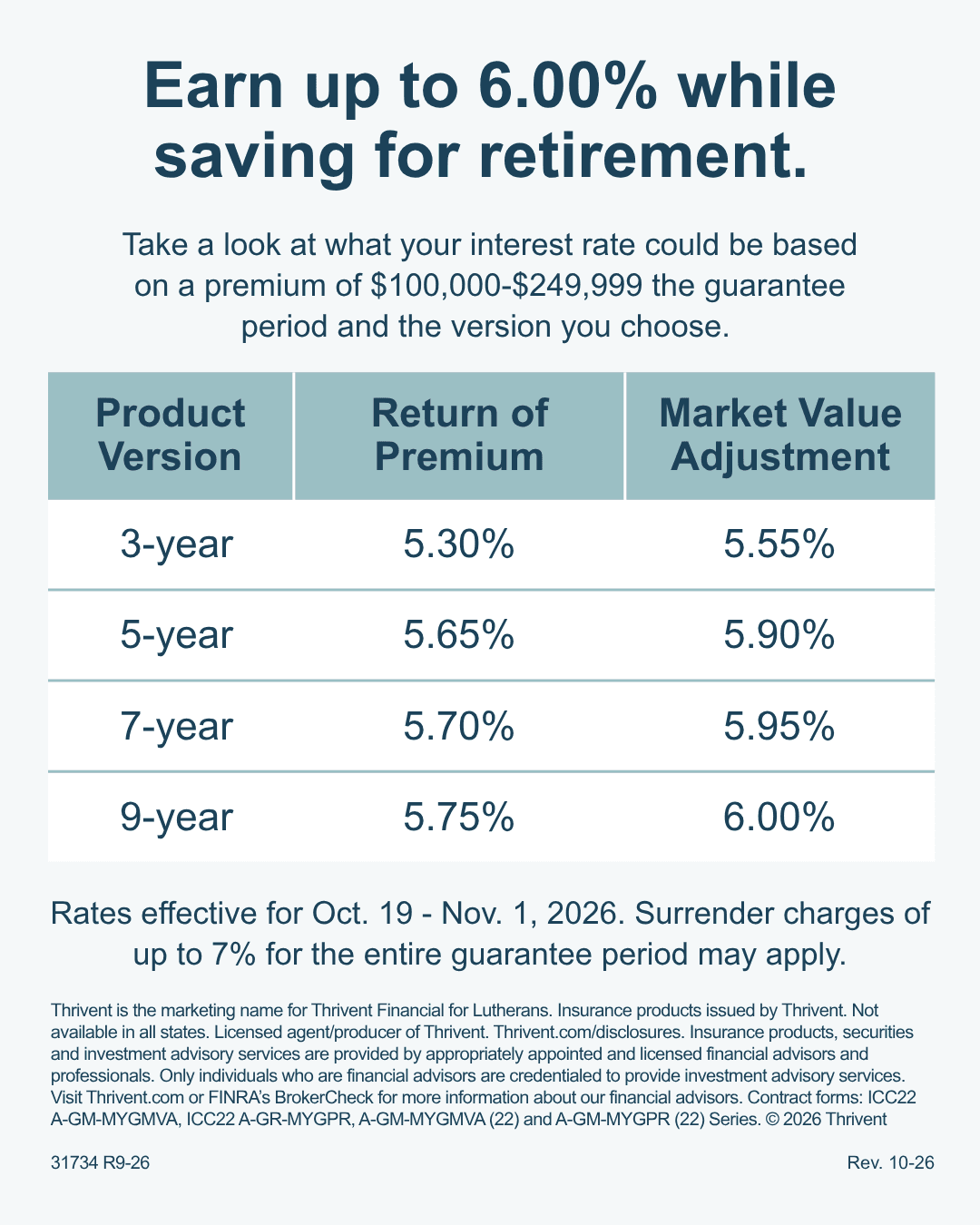
Help prepare for retirement with confidence by getting a locked-in interest rate for the guarantee period you choose—either 3, 5, 7 or 9 years—with a Thrivent Multi-Year Guarantee Annuity™.
This single premium fixed deferred annuity offers:
• Dependable interest
• Tax-deferred earnings
• Protection from market risk
Contact me today if you want to discuss if this is right for you.
For additional interest rates and other important information: https://bit.ly/4fFumVI
See thrivent.com/social for important disclosures.

When the Business Is the Financial Plan
Your business may be your greatest asset.
It may also be your biggest financial concentration.
The same company can drive your income, net worth, retirement expectations, family security and future legacy.
That isn't automatically a problem. It is a tradeoff.
The question is whether that concentration exists by design—or simply because the business kept growing faster than everything around it.
What happens if:
The sale takes longer than expected?
A key employee or customer leaves?
The valuation comes in below the number in your head?
You want to step away before the business is ready?
Planning ahead can help owners understand the tradeoffs before they are forced to make a decision.
This isn't necessarily about selling or moving money out of the business.
It's about knowing how much of your financial future depends on one outcome—and whether the rest of the plan can stand on its own.
See thrivent.com/social for important disclosures.

Private Equity Is Not Just "Stocks Before the IPO"
Private equity is often described as investing in companies before they reach the public market.
That description is incomplete.
Yes, companies are generally reaching the public market later than they did in prior decades. But much of private equity involves buying and reshaping established companies, not just backing companies on their way to an IPO.
Private equity is not simply an earlier version of public-stock investing.
The structure is different.
Capital may be committed for years. Valuations may depend on estimates rather than daily market prices. Fees and expenses can be more complex. Tax reporting may require additional coordination. Outcomes can vary significantly by manager, strategy, vintage and underlying company—and investors can lose money.
Depending on the offering or structure, participation may also be restricted by financial or other eligibility requirements.
Private equity can be appropriate for some investors with an appropriate time horizon, liquidity profile and ability to evaluate and bear the risks.
But exclusivity is not an investment thesis.
The better question is: "What problem would this allocation solve—and what flexibility would I be giving up in exchange?"
Sources: SEC; Nasdaq; Fidelity Institutional.
See thrivent.com/social for important disclosures.

How an allowance for kids teaches financial lessons for adulthoodLooking for a way to teach your children the value of money? An allowance can help them understand the basics of budgeting and saving. Here are some things to consider before giving out an allowance. ⬇️

Who Lends When a Bank Loan Doesn't Fit?
Who lends to a middle-market company when traditional bank financing isn't available, or simply doesn't fit the situation?
Increasingly, one answer is private credit.
Private credit generally involves loans made to businesses by nonbank investment vehicles. A 2025 Federal Reserve research note estimates that the U.S. market reached approximately $1.34 trillion by mid-2024—roughly five times its 2009 size.
For companies, it can expand the range of available financing. For investors, it can provide exposure to a different segment of the lending market.
But the word credit should not be confused with cash-like or low risk.
Private-credit investments can involve borrower default risk, illiquidity, leverage, limited transparency and assets that may be difficult to value because they do not trade on established exchanges. Fees, structure and manager underwriting can materially affect the outcome. Access may also be limited by investor eligibility or the investment vehicle being used.
So the useful question isn't: "Is private credit attractive?"
It's: "What role would it serve—and are its risks, liquidity limits and structure appropriate for the investor?"
Sources: Federal Reserve Board; SEC; FINRA.
See thrivent.com/social for important disclosures.
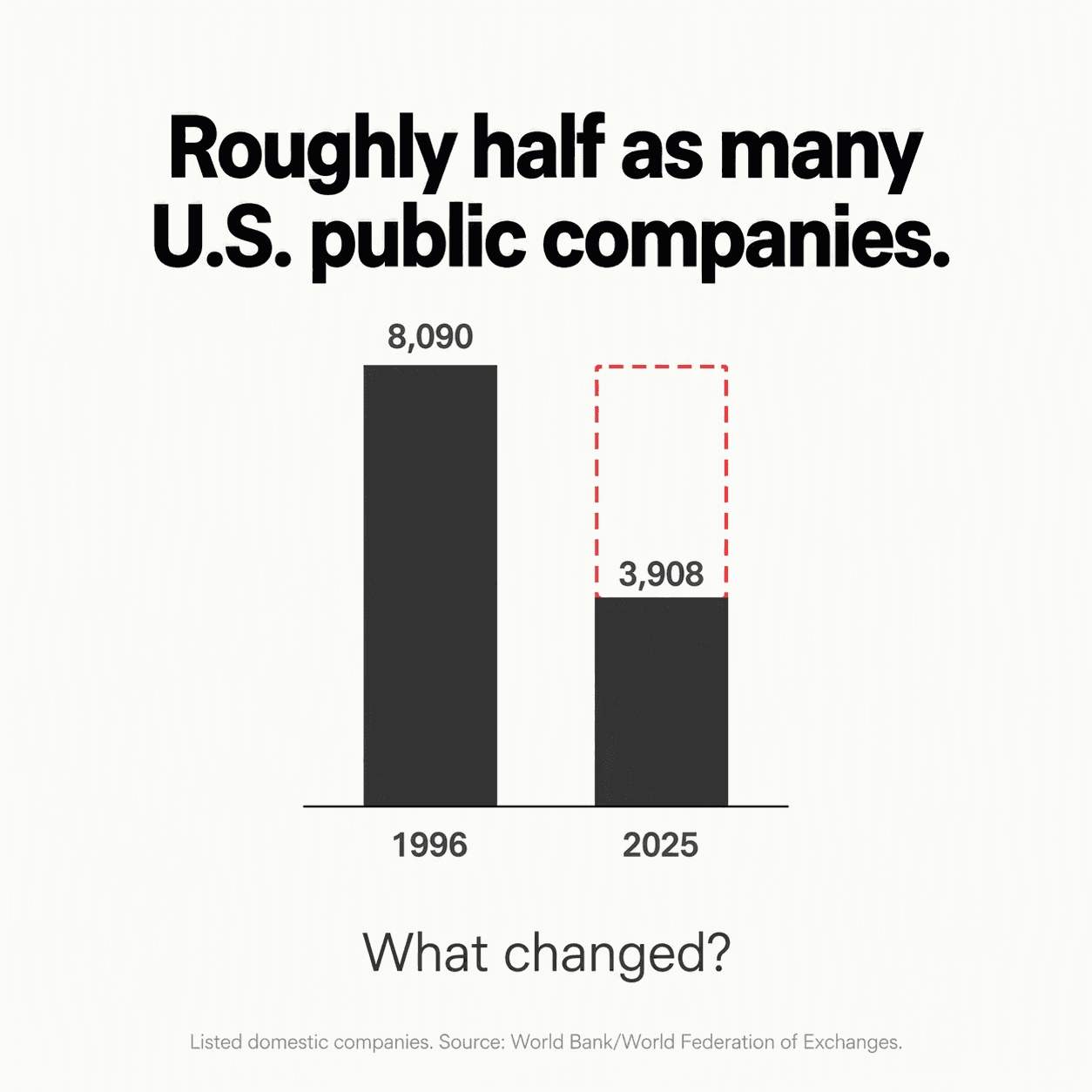
The number of U.S. publicly listed companies is roughly half what it was at its 1990s peak.
World Bank data, sourced from the World Federation of Exchanges, shows 8,090 listed domestic companies in 1996 versus 3,908 in 2025.
At the same time, research on the IPO market shows that companies are generally going public later and at a more mature stage than they did a generation ago.
That doesn't mean public markets are disappearing.
And it doesn't mean private markets are automatically better.
It means the investable landscape has changed, with many companies staying private longer before going public.
For investors, the question isn't:
"How do I get access to everything?"
It's:
"Which opportunities, if any, fit my goals, time horizon, liquidity needs and ability to absorb loss?"
Private investments may offer exposure to companies and strategies unavailable in public markets, but they may also bring limited liquidity, less transparent valuations, higher fees, complex tax reporting, eligibility requirements and substantial risk.
Access is not the same as suitability.
Want to talk through how this applies to you? Let's set up a time to chat.
Sources: World Bank/World Federation of Exchanges; University of Florida IPO Initiative.
See thrivent.com/social for important disclosures.

Somewhere in an HR portal, there's a number that decides how your family would live without you.
You chose it during open enrollment. Then life kept moving.
𝗧𝗵𝗲 𝗯𝗼𝘅 𝘆𝗼𝘂 𝗰𝗹𝗶𝗰𝗸𝗲𝗱 Open enrollment, a few years back. "Basic Life." A choice that fit your life at the time.
Among Americans who own life insurance, 27% have it only through work.
Workplace coverage can be a solid start. It's also an easy decision to set and not revisit.
𝗧𝗵𝗲 𝗱𝗲𝘁𝗮𝗶𝗹𝘀 𝘄𝗼𝗿𝘁𝗵 𝗮 𝘀𝗲𝗰𝗼𝗻𝗱 𝗹𝗼𝗼𝗸 • The amount may be based on a formula, like a multiple of salary, rather than your mortgage, your kids or your plans. • It's often tied to the job. Change jobs, or lose one, and it may change or end. • Your life may have changed since you enrolled. Your coverage may not have.
𝗧𝗵𝗲 𝗳𝗼𝘂𝗿-𝗾𝘂𝗲𝘀𝘁𝗶𝗼𝗻 𝗰𝗵𝗲𝗰𝗸𝘂𝗽 • Do you know your coverage amount without logging in? • If it paid out tomorrow, how many years would it carry the people who count on you? • What happens to it if you leave your job? • Does anyone at home know it exists, or where to find it?
That last one is worth a conversation at home.
𝗪𝗵𝗼 𝘁𝗵𝗶𝘀 𝗶𝘀 𝗿𝗲𝗮𝗹𝗹𝘆 𝗳𝗼𝗿 Life insurance is the one financial decision you make entirely for someone else. As your life changes, it's worth making sure it still fits.
If you'd like a second set of eyes on what you have, send me a message. Sometimes the answer is "you're in good shape." That's worth knowing too.
Source: LIMRA, 2026 Facts About Life Insurance: Workplace Benefits. See thrivent.com/social for important disclosures.
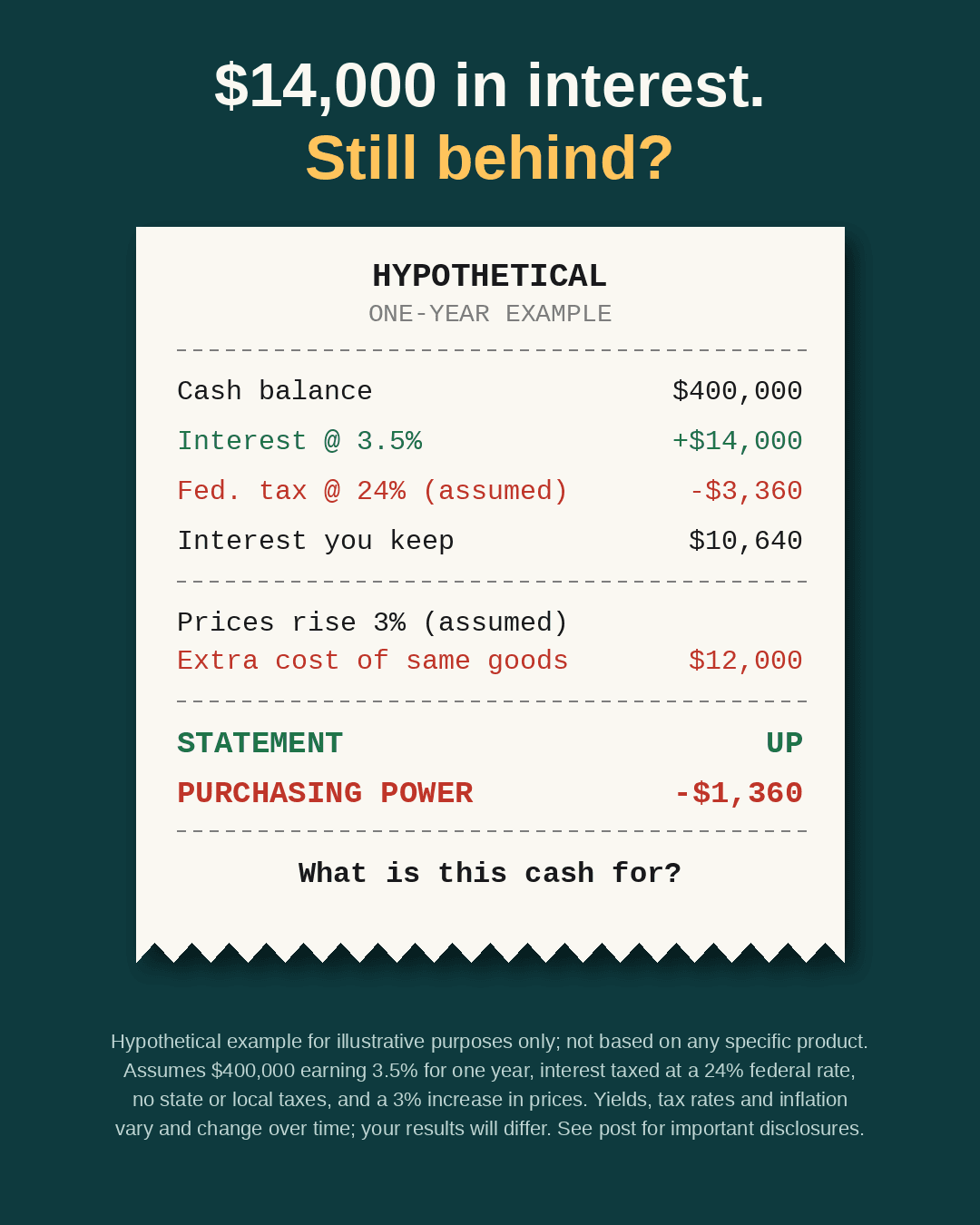
$400,000 can earn $14,000 in interest and still fall behind.
Here's the math most statements don't show.
𝗧𝗵𝗲 𝗰𝗼𝗺𝗳𝗼𝗿𝘁𝗮𝗯𝗹𝗲 𝗽𝗮𝗿𝘁 Strong income. House handled. No big purchases coming up. A healthy amount sitting in cash.
That's not a mistake. Cash does important work: emergencies, near-term goals, flexibility and peace of mind.
𝗧𝗵𝗲 𝗾𝘂𝗶𝗲𝘁 𝗺𝗮𝘁𝗵 A hypothetical, one-year example: • $400,000 earning 3.5% = $14,000 in interest • That interest is taxable income to you. At an assumed 24% federal rate, about $3,360 goes to taxes • You keep about $10,640 • If prices rise 3% that year, it takes about $12,000 more just to buy the same things
The statement goes up. Purchasing power slips by about $1,360.
To keep pace in this example, cash would need to earn roughly 3.95% before taxes.
𝗧𝗵𝗲 𝘀𝗰𝗿𝗶𝗽𝘁 𝗻𝗼𝗯𝗼𝗱𝘆 𝘀𝗮𝘆𝘀 𝗼𝘂𝘁 𝗹𝗼𝘂𝗱 "Cash is safe."
Cash doesn't swing with the stock market. It is still affected by taxes and inflation. Every choice has a tradeoff, including this one.
𝗧𝗵𝗲 𝗯𝗲𝘁𝘁𝗲𝗿 𝗾𝘂𝗲𝘀𝘁𝗶𝗼𝗻𝘀 • What is this cash actually for? • How much do you want within reach, and why? • Which goal keeps getting pushed to "next year"?
Sometimes the answer is to keep it right where it is. The point is knowing why.
𝗪𝗵𝗲𝗿𝗲 𝗜 𝗰𝗼𝗺𝗲 𝗶𝗻 If you're holding more cash than you've needed in years and want to talk through the role it plays, send me a message.
Hypothetical example for illustrative purposes only; not based on any specific product. Assumes a $400,000 cash balance earning a 3.5% annual yield for one year, interest taxed at a 24% federal income tax rate, no state or local taxes, and a 3% increase in prices. Yields, tax rates and inflation vary and change over time, and your results will differ. Thrivent and its financial advisors and professionals do not provide legal, accounting, or tax advice. Consult your attorney or tax professional. See thrivent.com/social for important disclosures.

Who is coordinating your entire financial life while you're busy outperforming your brother-in-law's portfolio?
Hopefully, the answer is not five separate logins and Future You.
That is the part self-directed investors rarely brag about.
𝗧𝗵𝗲 𝗽𝗮𝗿𝘁 𝘆𝗼𝘂 𝗺𝗮𝘀𝘁𝗲𝗿𝗲𝗱
You research funds.
You understand fees.
You rebalance.
You did not chase the stock your cousin mentioned at Thanksgiving.
Honestly, that already puts you ahead of plenty of people.
But choosing investments is only one room in the house.
𝗧𝗵𝗲 𝗵𝗮𝗹𝗹𝘄𝗮𝘆 𝗻𝗼𝗯𝗼𝗱𝘆 𝗽𝗼𝘀𝘁𝘀 𝗮𝗯𝗼𝘂𝘁
The accounts may be doing fine individually while working poorly together.
Taxable, tax-deferred and tax-free money may not be positioned intentionally.
Beneficiaries may still reflect an older chapter.
Insurance may not match the life the portfolio is supposed to protect.
Cash may have no defined job.
Retirement withdrawals may be an eventual problem assigned to Future You, who is apparently very well-rested and loves paperwork.
None of that shows up in today's return.
𝗧𝗵𝗲 𝗿𝗲𝗮𝗹 𝘀𝗸𝗶𝗹𝗹 𝘁𝗲𝘀𝘁
The question is not whether you can pick investments.
It is whether every financial decision is pulling in the same direction.
Investment strategy.
Tax alignment.
Income protection.
Retirement distribution.
Estate and beneficiary coordination.
That is a system, not a watchlist.
𝗪𝗵𝗲𝗿𝗲 𝗮𝗻 𝗮𝗱𝘃𝗶𝘀𝗼𝗿 𝗰𝗮𝗻 𝗮𝗱𝗱 𝘃𝗮𝗹𝘂𝗲
You may not need someone to take the wheel.
You may need a second set of eyes to find the blind spots you cannot see from the driver's seat.
If you manage your own money and want to pressure-test how the pieces work together, send me a message. Sometimes good investing needs no replacement. It just needs better coordination.
Thrivent and its financial advisors and professionals do not provide legal, accounting, or tax advice. Consult your attorney or tax professional.
See thrivent.com/social for important disclosures.

“I know I messed up. I'm just too embarrassed to tell a financial advisor.”
If that's the sentence keeping you from reaching out, you don't have to say it perfectly. You can start there.
𝗪𝗵𝗮𝘁 𝘆𝗼𝘂 𝗺𝗶𝗴𝗵𝘁 𝗯𝗲 𝗰𝗮𝗿𝗿𝘆𝗶𝗻𝗴
Maybe you waited too long to start saving. Took on debt. Cashed out an account. Or simply stopped opening the statements.
Then comes the second worry: “What will they think of me?”
𝗪𝗵𝗮𝘁 𝗜'𝗱 𝘄𝗮𝗻𝘁 𝘆𝗼𝘂 𝘁𝗼 𝗸𝗻𝗼𝘄
You don't need to tidy up your finances before talking to me. You don't need to know every balance or have an explanation ready for every decision.
We can start with what you know, what feels most pressing, and what you want to understand better. Some decisions may need attention soon. Others can wait until there's a clearer picture.
No lecture. No “you should have known better.” That sentence has never helped anyone make their next decision.
𝗧𝗵𝗲 𝗳𝗶𝗿𝘀𝘁 𝘀𝘁𝗲𝗽
If you've been putting off the conversation because you're embarrassed, you can message me with just this:
“I don't know where to start.”
That's enough to start talking.
See thrivent.com/social for important disclosures.

Navigating open enrollment: 5 ways to make the best choices for your familyOpen enrollment is your opportunity to make choices that will protect and support your family throughout the year. Take a look at this helpful guide before you get started. Let’s connect if you want to discuss which options are the right fit for your family’s needs.

2022 didn’t prove the 60/40 portfolio was dead.
It proved that correlation is not a law of nature.
For much of the period after 2000, stocks and bonds often moved differently enough for bonds to help offset stock-market stress. But that relationship has changed across history—and inflation is one of the variables associated with those shifts.
In 2022, stocks and bonds declined together. A traditional 60% U.S. stock/40% U.S. bond portfolio finished down just under 16%, its worst calendar year since the 2008 financial crisis.
That doesn’t make traditional diversification useless.
It does make one question worth asking:
What assumptions is your portfolio relying on—and what happens when those assumptions temporarily stop working?
For some qualified investors, certain alternative strategies may provide differentiated return drivers. But “different” does not mean safer or guaranteed to diversify. Depending on the strategy, alternatives can involve illiquidity, complexity, higher fees, leverage, valuation uncertainty, limited transparency, eligibility requirements and risk of loss.
The goal isn’t to abandon stocks and bonds.
It’s to understand what each part of the portfolio is actually designed to do.
Sources: Morningstar; CFA Institute Research and Policy Center, FINRA
See thrivent.com/social for important disclosures
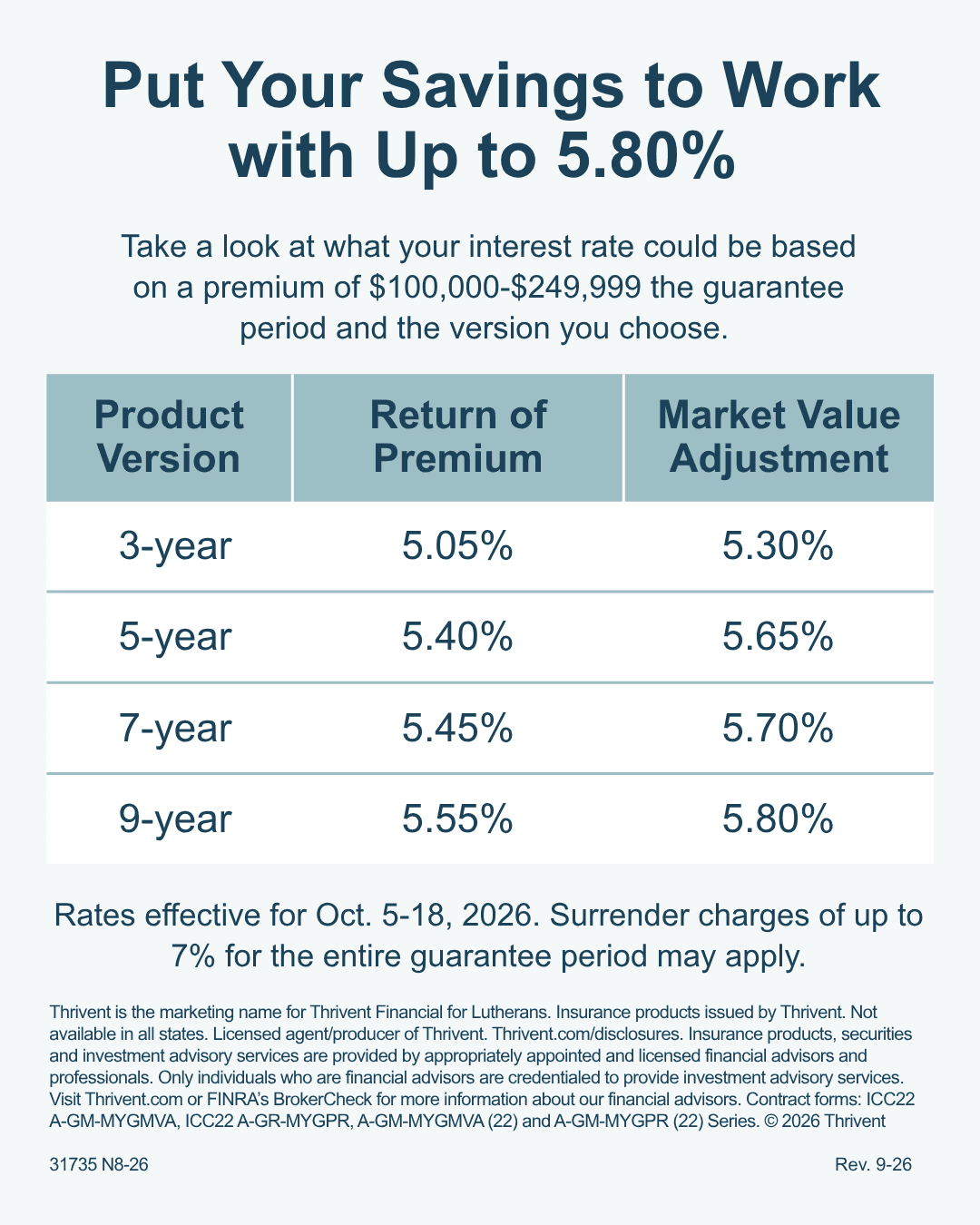
A Multi-Year Guarantee Annuity™ allows you to lock in a guaranteed interest rate for a set period, making it a popular option for those looking to help add stability, predictable earnings, and reduced market uncertainty.
Reach out if you'd like to discuss whether this type of solution could help support your retirement goals.
For additional interest rates and other important information: https://bit.ly/4fIaSQk
See thrivent.com/social for important disclosures.

You probably have a protection plan on a $1,200 phone.
So what's protecting the thing that pays for the phone?
𝗧𝗵𝗲 $𝟲 𝗺𝗶𝗹𝗹𝗶𝗼𝗻 𝗮𝘀𝘀𝗲𝘁 𝗻𝗼𝗯𝗼𝗱𝘆 𝗹𝗶𝘀𝘁𝘀 Hypothetically: earn $200,000 a year for the next 30 years, and that's $6 million in future paychecks. Before a single raise.
That's more than the house. More than the 401(k). More than everything in the garage combined.
And all of it depends on one thing: you being able to work.
𝗪𝗵𝗮𝘁 𝘄𝗲 𝗶𝗻𝘀𝘂𝗿𝗲 𝘃𝘀. 𝘄𝗵𝗮𝘁 𝗽𝗮𝘆𝘀 𝗳𝗼𝗿 𝗶𝘁 The car: insured. The house: insured. The phone: insured, plus the cracked-screen add-on. The paycheck that covers all three: "Eh, I'm healthy."
𝗜𝘁'𝘀 𝗻𝗼𝘁 𝗮𝗹𝘄𝗮𝘆𝘀 𝘁𝗵𝗲 𝘀𝗰𝗲𝗻𝗲 𝘆𝗼𝘂 𝗽𝗶𝗰𝘁𝘂𝗿𝗲 It isn't always a dramatic accident. It can be a back injury. A diagnosis. A recovery that takes longer than anyone expected.
The mortgage doesn't pause while you heal.
𝗧𝗵𝗲 𝘁𝗵𝗿𝗲𝗲-𝗺𝗶𝗻𝘂𝘁𝗲 𝘀𝘁𝗿𝗲𝘀𝘀 𝘁𝗲𝘀𝘁 • If you couldn't work for a year, how many months would your savings carry you? • If you have coverage through work, do you know how much of your pay it would replace? • Would that coverage follow you if you changed jobs?
If those answers came slowly, you're in good company. Plenty of people know their phone plan better than their income plan.
𝗧𝗵𝗲 𝗿𝗲𝗳𝗿𝗮𝗺𝗲 Your ability to earn may be the most valuable thing you own. It deserves at least as much attention as your phone.
If you'd like to walk through how your income is protected today, send me a message.
Hypothetical example for illustrative purposes only. See thrivent.com/social for important disclosures.

A couple of weeks later, I'm still thinking about the food at St. Sharbel's Taste of Lebanon festival.
Events like this are a reminder of what community feels like: neighbors, family, music and way too many trips back for one more plate.
Thank you to the organizers and volunteers who made it happen.